Sir, This Is a Two-Episode OVA: A Eulogy for Hentai's Most Overwritten Scripts
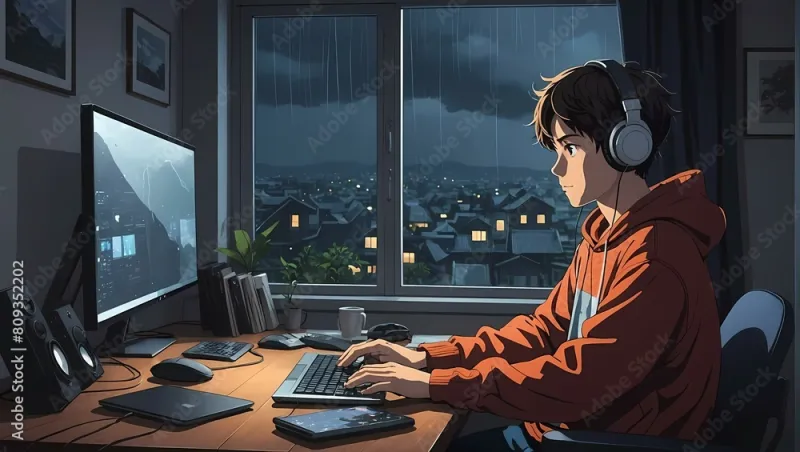
Photo: frustrated person watching anime on laptop at night cinematic, via as1.ftcdn.net
Let me describe a show to you. It opens on a rain-slicked city. A narrator with a voice like expired cough syrup explains that in the year 20XX, an ancient covenant between humans and spirit-kind has begun to fracture. There are four — sorry, five — factions. One of them has a council. The council has a traitor. We know this because episode one spends eleven uninterrupted minutes on a meeting where hooded figures speak in riddles about a prophecy.
There are two characters. You will not see them again for a while.
I want to be clear about what I'm not arguing here. I'm not one of those 'it's porn, why do you need a plot' people — that take has been beaten to death and it was wrong the first time. Plot is good. Motivation is good. A story about two people who actually want each other hits infinitely harder than two strangers colliding because the script said so. The problem isn't plot. The problem is a specific, identifiable disease I'm calling Blade Runner Brain, and the adult anime industry has it bad.
Symptoms of Blade Runner Brain
The telltale sign is the ratio. When world-building footage outnumbers the reason anyone clicked by more than three to one, you've got a problem. When the protagonist's tragic backstory — delivered, naturally, in flashback, in the rain, over a piano — takes longer than any single scene in the actual present day, you've got a bigger one.
The genre's most chronic offenders share a pattern. They're adaptations of long-running source material where the studio clearly loves the world more than the assignment. They open with a cold read of the entire setting as if the viewer is studying for the exam. And they save their emotional payoffs for a 'climax' that is 60% dramatic monologue, 40% everything else.
I once watched an episode that ended on a cliffhanger about the political fate of a kingdom. Not a romantic cliffhanger. A geopolitical one. I had to sit with that.
How We Got Here
There's a generous reading of all this, and it goes something like: the directors care. The VHS-era classics that built this industry's reputation — the ones everyone my age found on a mislabeled tape — worked precisely because they were ambitious. They had atmosphere, mystery, dread. The DNA of cyberpunk and dark fantasy runs straight through the genre's greatest hits. When a modern OVA opens on a moody skyline and a prophecy, it's doing an impression of the stuff that made us fans in the first place.
The less generous reading is budget math. World-building is cheap. Narration over stills and establishing shots costs a fraction of what animation costs. A director handed three episodes and a thin budget has every incentive to stretch the talky parts and compress the parts that require key frames. Blade Runner Brain, in many cases, is just poverty wearing a trench coat.
The 20-Minute Rule
Here's my modest proposal, and I'm calling it the 20-Minute Rule: if your title hasn't given the audience what they came for within the first twenty minutes, you owe them either a refund or an apology. Everything after that point is a director making a movie for themselves and billing it as something else.
And before the comments fill up with 'just skip ahead' — I've tried. Skipping ahead in an overwritten hentai is uniquely miserable, because the plot you're skipping is load-bearing. Skip the council scene and the betrayal makes no sense. Skip the betrayal and the forgiveness makes no sense. These scripts are woven like a cable-knit sweater. You cannot untangle one thread without the whole thing collapsing. That's craftsmanship of a sort, I suppose. It's also not what the box promised.
In Defense of the Delusional
Here's the twist ending, though: I wouldn't fully cure it. The overwritten, overambitious, terminally serious hentai is a dying art, because the economics that produced it are gone. The modern market rewards short-form, fast-payoff content, and something is lost when every title is engineered for the first ninety seconds of viewer attention.
So let the record show that when a director spends forty minutes building a doomed kingdom so that two characters can have one scene together in the ruins, I complained the entire time — and I watched all of it. Twice. Some sins are worth committing. Just, please, next time: open with the scene. I promise the council will still be there.


